
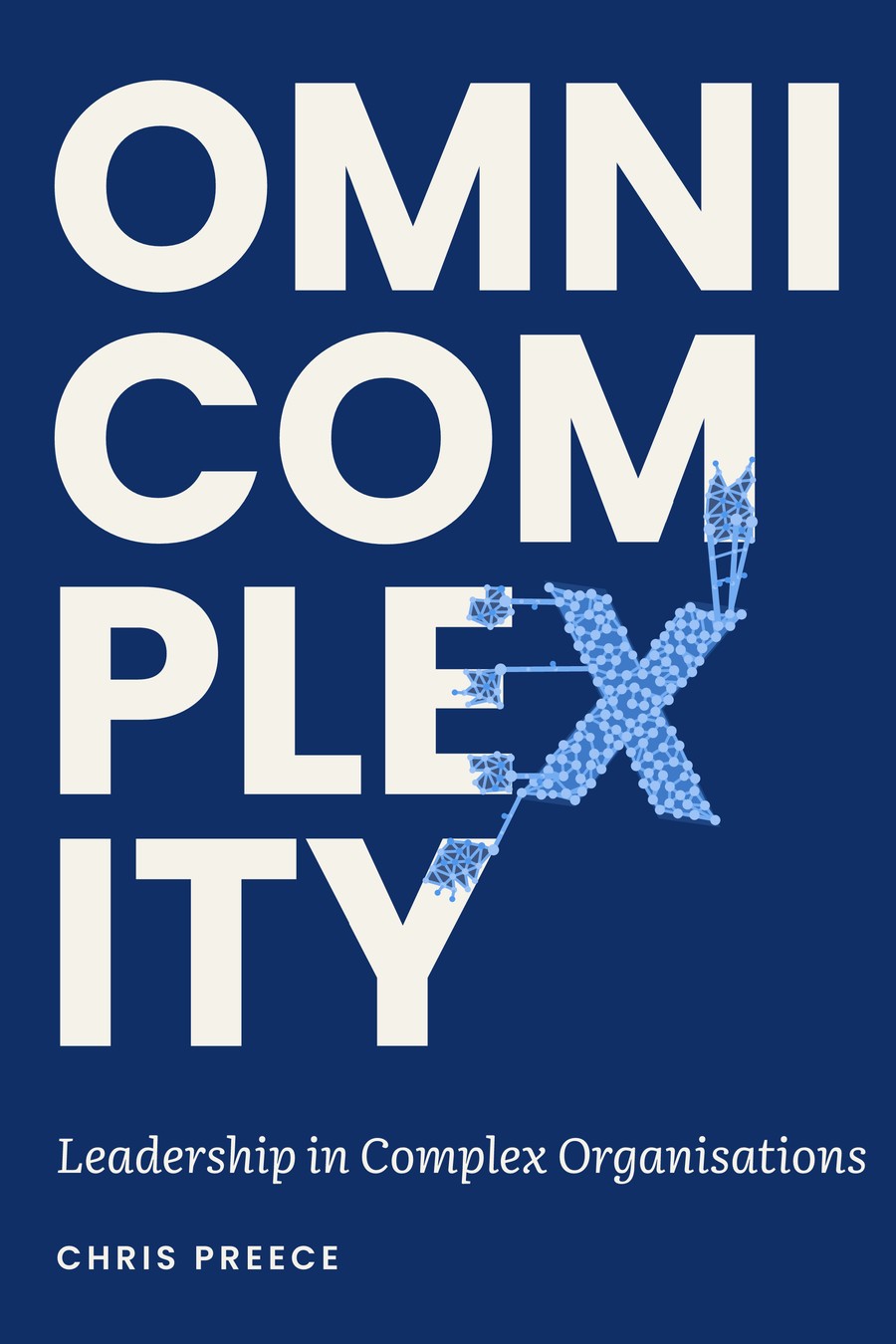
Omnicomplexity: Leadership in Complex Organisations
A practical book on why change fails in complex organisations, and what to do instead.
Every leader's instinct, and every rival's pitch, is to reduce complexity by adding order: more governance, more reporting, more standardisation. This book shows what that order actually costs. The bill is drawn from a hidden account, your people's capacity to respond when something surprises them, and it is recorded nowhere. Then it sets out a different way: put decisions where the facts are, and leave practices your teams keep running after you step back.
Coming 2026. Read the first chapter now, and be first to hear when it launches.
Chris Preece has spent decades leading change in emergency services, national programmes and UK central government. At Registers of Scotland, he was one of the people who took the land registry from paper to digital, end to end, in three weeks, through the first weeks of the pandemic. The book is drawn from programmes like that one: what moved them, and what usually stops change from holding.
Not every account in the book is a success. One chapter follows a company where good people could see what the work needed and had no authority to act on it. Chris made the case, coached, and argued for putting decisions with the people who could see the work; after about six months it was clear the structure would not move, and he left. The book includes what did not work, and why.
Every story in the book is real, and Chris was inside each one
In fire and rescue, a product that went from a sixth of the UK market to a third, against the established suppliers.
Registers of Scotland, from paper to digital in three weeks, through the first weeks of the pandemic.
Casework that had run to eighteen months, finishing in under thirty days.
What this book will change
Where you look
You will see where delivery actually depends on a few people absorbing problems, and what that is costing, before it fails.
Where decisions sit
You get one question to ask of any decision: is it being made anywhere near the people who can see the work?
What control costs
You will see what control, reporting and standardisation actually cost you in speed and time, and decide what is worth paying for.
What to do next
A small set of practices to try with your own teams, including a peer coaching format that runs without an expert in the room.
How the book is built
Fifteen chapters, a coda, a closing and a practice, in 252 pages. The chapters run in three movements. A prologue and a note on how to read the book sit at the front; a glossary, a bibliography and an index sit at the back.
The Lens
Where the idea that organisations run like machines comes from, and the true stories of it failing.
- 1The Dull Art of Estimating Estimates
- 2Human Mouse Movers
- 3A Spinning Plate Looks Still
- 4Capturing Fog With a Net
- 5You Cannot Post a Land Registry
The Single Field
The book's central claim: there is no naturally ordered state to return to, and the order you have is held in place by people, at a cost.
- 6What If You're Wrong?
- 7There Is No Ordered Place
The Craft
What leading looks like from inside: where decisions belong, who can change the rules that slow teams down, and what to do next.
- 8The Heatproof Gloves
- 9The Say Belongs Where the Facts Are
- 10Silence Is Accuracy
- 11The Most Informed Shipwreck in the World
- 12When the Rule Lives Elsewhere
- 13Nobody Transforms Anything
- 14Isn't This Just Agile?
- 15And on Monday
- Coda: The Joke That Turned Out to Be True
- Closing
The Practice
The Five Passes: a way to work your own situation with the people you actually work with. Read all five here.
- Going Further: Working Your Own Situation
Ways of looking at your own work
It is not a framework and there is nothing to score.
The book gives you ways to look at your own work: where decisions belong, who can actually change the rules that slow your teams down, how to spot a change that will fail before it costs you money, and what to try with your teams next. It gives you one test for whether a change is real: does it survive the first time somebody with the power to reverse it disagrees? If it only holds while nobody senior objects, nothing has really changed. You can call it in advance, not read it off the outcome. The stories carry the argument, and the Going Deeper essays put named, cited scholarship under every claim.
What the book builds on
A few of the thinkers it draws on:
- Elinor Ostrom, on why a room can see a problem clearly and still hold no standing to change the rule that keeps making it.
- Ralph Stacey, on organisations as people relating, with influence and never full control.
- Karl Weick, on organising as a thing people do, and on sense being made after the act.
- Haridimos Tsoukas, on change as the constant condition, with stability the costly thing laid over it.
- Mary Parker Follett, on both sides taking their orders from the situation itself.
- Max Boisot, on growing your own internal complexity to match a complex world.
Alongside James C. Scott, Erik Hollnagel, Lucy Suchman, Edwin Hutchins and others, each cited in full in the Sources.
Who it is for
It is written for senior managers responsible for delivery, change and structure: leaders who have watched transformation programmes underdeliver, watched methods copied from another organisation stop working on arrival, and watched good teams grind against tidy plans. It is for readers who want rigour without jargon. The scholarship is real and cited, the stories are true, and the book is clear about what would prove it wrong.
It is not an airport business book. It is one argument, built carefully across true stories, and written to be tested against your own organisation.
Read the first chapter
Chapter one, straight after you confirm your email, and first news when the book launches. Nothing else, no spam. If it is not useful, one click unsubscribes you.
More than the first chapter: join the launch team and get the full ebook free before it goes on sale. Reading it with your team? Reading groups and copies for your team.

Chris Preece
Chris Preece has spent decades leading change in emergency services, national programmes and UK central government. Of his years in the fire and rescue market: “We helped take the product from a sixth of the UK market to a third, against the established suppliers,” he says. When the pandemic closed its offices, he was one of the people who took Registers of Scotland from paper to digital in three weeks.