
The Five Passes
A solo practice for working your own situation. Bring one live situation you are genuinely caught up in right now, not one you only advise on from the outside. The Five Passes are five questions you put to that situation, answering as someone inside it rather than a neutral observer.
They are not steps and no order matters. You start wherever pulls hardest, and you end on one move that is yours to make this week. Nothing is scored and there is no diagram to fill in. It is drawn from the book Omnicomplexity, and you can do it on your own.
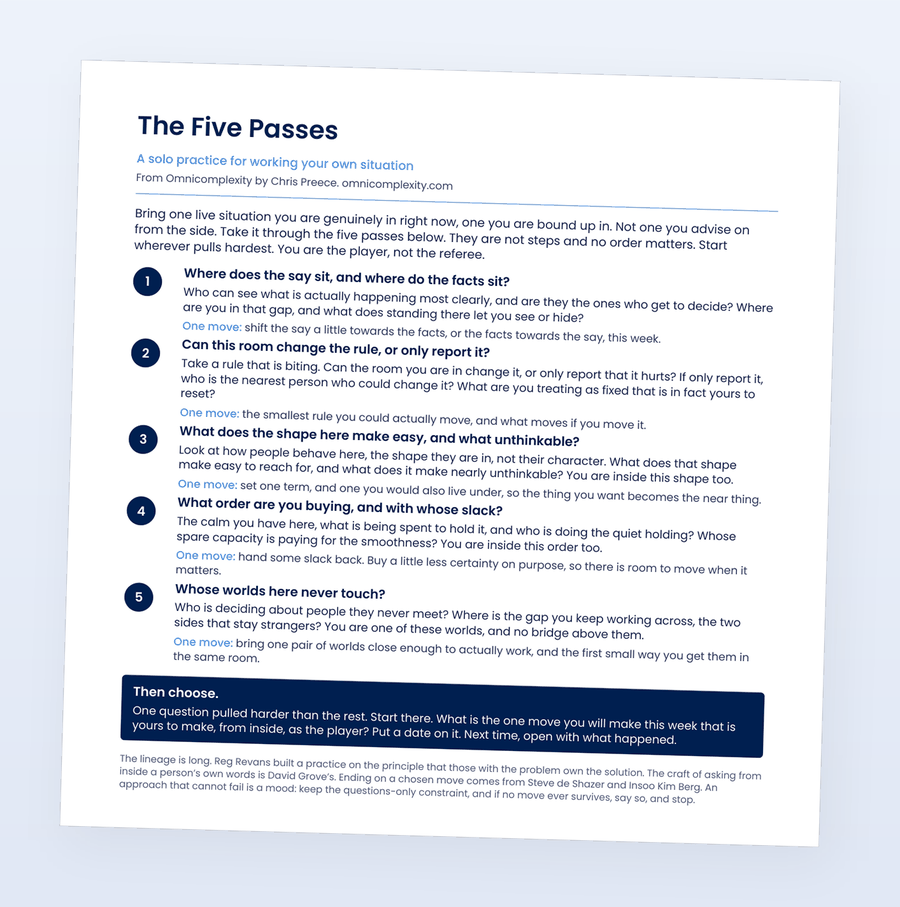
The five passes
Take your one situation through these five. Each pass names a question and one small move you could make out of it this week.
One. Who gets to decide, and who can see what is actually happening?
This pass separates two things that usually get bundled together: who can see what is actually happening, and who gets to decide. When those sit in different places, information has to travel between them, and something gets lost on the way. Often it names a gap you have been working around for months. You are somewhere in that gap yourself, so it is worth asking what your position lets you see and what it hides.
One move: move the decision a little closer to the facts, or the facts a little closer to whoever decides.
Two. Can this room change the rule, or only report it?
Take a rule that is getting in the way. This pass asks whether the people you are actually with can change it, or can only report that it is a problem. It sorts what you have been treating as fixed from what is actually yours to reset. Some of what you treated as beyond anyone's control turns out to be a rule you set yourself. Some of what felt like your fault turns out to sit with people you cannot reach yet.
One move: change the smallest rule you actually can, and watch what else shifts when you do.
Three. What does the way this is set up make easy, and what does it make almost impossible?
Look at how people behave here, and before you put it down to character, look at the structure they are working inside. This pass finds what that structure makes the easy thing to do and what it makes nearly impossible. It turns resistance into useful information: the person who keeps blocking you is usually doing the sensible thing for the structure they are in. It also turns the question back on you, because you are inside this structure too, and it is quietly making some things easy for you as well.
One move: set one rule that you would also live under yourself, so the thing you want becomes the easy thing to do.
Four. What is the smooth running here costing, and whose spare capacity pays for it?
The smooth running here is being paid for by someone. This pass asks who is quietly holding things together, and whose spare capacity is paying for it. The answer is often someone further down the line and quieter than you, and sometimes it is you carrying it for someone else. It also asks what would still have room to give if tomorrow turned hard.
One move: hand some spare capacity back, and accept a little less certainty on purpose, so there is room to move when it matters.
Five. Which groups here decide about each other but never actually meet?
This pass looks for the people who make decisions about others they never meet, and the gaps you keep working across where two sides stay strangers. That distance usually causes problems neither side intended. And you are one of these groups yourself, not above them, so the group you most need to understand is often the one you deal with least.
One move: bring one pair of these groups close enough to work together, and take the first small step to get them in the same room.
Then choose.
By now one question has probably pulled harder than the others. Start there. Name the one step you will take this week, make sure it is yours to make, and put a date on it. Writing the step down is only the start. What matters is what has changed when you come back to it next time.
How to run it
Give it half an hour. Do it alone, on paper, with one situation you are genuinely stuck in right now, not one you only advise on. Read the five passes through once, then go back to the one that pulled hardest and stay there.
Answer in your own words, out loud or on the page, and be honest about your own part in it. Do not try to finish all five in one sitting. It is built to end on one step: something small, yours to make, with a date on it. That is the point of the half hour. You finish with one concrete step you can take this week.
Then, next time, open with what happened to the last move before you start a new pass.
Who it is for
Anyone carrying a situation they cannot fix from the org chart: a change that keeps stalling, a rule that gets in the way, or a team grinding against a tidy plan. You do not need permission, a workshop or a consultant to use it, just one honest situation and half an hour on your own.
It works on your own, and it works better shared. Behaviour spreads person to person, and one person reading a page alone rarely changes how a team works. Handing this page to someone you actually work with, and thinking one situation through together, does more. That is how change actually spreads, one person at a time.
What it is not
It is not a framework and there is nothing to score. There are no stages, no levels, and no quadrant you get sorted into. It does not sort your situation into a type and then hand you the matching fix, because that would quietly move the decision away from you and towards whoever did the sorting.
It is not a diagram to fill in and it is not a workshop you have to book. Five is not a special number; these are simply five useful ways to look at your own situation, and they are not the only ones. They are starting points, and they work best once you have put them in your own words for your own situation.
Get the kit when it ships
Next comes a reading-group kit: four sheets for running the book with people you actually work with, and the Five Passes card is Sheet 4. The kit is not ready yet. Tell us where to send it and we will email it to you as soon as it is, with launch news for the book. Nothing else, no spam. One email here is the only gate the kit will ever have. The kit itself is yours to copy and hand on to the people you actually work with.